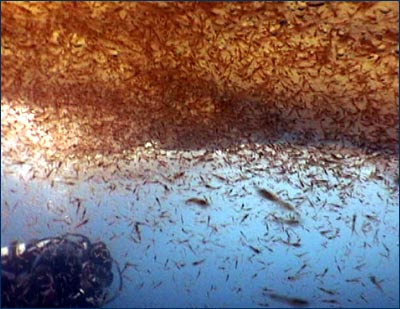
The blue whale's main source of diet is krill. Krill are tiny animals,
about the size of shrimp. It is crazy to think that the largest animal to ever live on our planet eats
something so small. During their main consumption period, blue whales
can eat up to 8,000 pounds of krill. For an average sized blue whale, it can
take up to about 2,200 pounds of food (krill) until their stomachs are
full (Rhoades).
When the blue whale eats, and it devours almost a whole swarm of krill, it also swallows thousands of gallons of water. To get rid of the water, the blue whale pushes it out through its baleen, which is a brush-like filter that blue whales have instead of teeth. The baleen, as the water leaves the blue whale's mouth, traps the krill inside (Loma).
During feeding season, blue whales live on two to four tons of krill every day. Feeding in polar summers occurs in Channel Islands, Monterey Bay, and Farallon Islands. During winter, they migrate to Mexico and Costa Rica where the climate is warmer. 2,800 blue whales feed along the coast of California, which is the biggest concentration of blue whales on Earth (Whitaker).