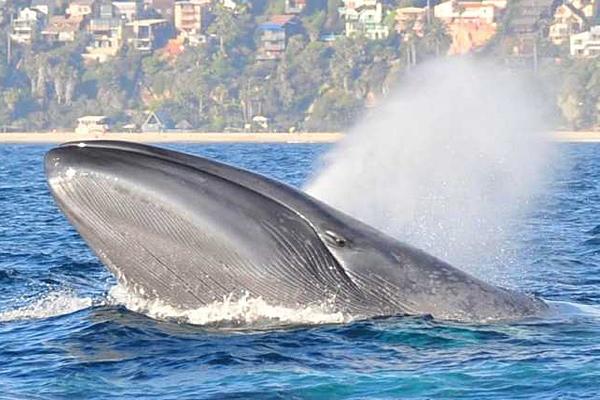
Blue whales share a similar lifespan to humans. A blue whale's full life can last between 80 and 90 years. However, there are instances of blue whales living beyond 100 years. For example, the oldest blue whale lived to be about 110 years of age (counting the rings on the ear wax plugs of a dead blue whale can help marine biologists find the age of a blue whale). Unfortunately, not all blue whales enjoy the luxury of living a life of more than 80 years. Threats posed by the blue whale's two known predators make for a life expectancy of about 35-40 years. The two predators of the blue whales who can bring them early deaths are humans and orcas, otherwise known as killer whales (Loma).
The killing of whales by humans (whaling) was impossible in the 19th century because the whales were "too swift" for traditional methods of fishing. Harpoon cannons caused whaling to take off and in 1931, the peak of whale killing, 29,649 blue whales were taken. Blue whales were considered endangered and whaling was outlawed in 1966 (Whitaker). Whaling continues, however, because it is difficult to enforce this law, especially in countries where whaling has been a prevalent part of the culture such as in the former Soviet Union and Japan. One example of whaling's damage is Antarctica. There, the population of blue whales was once in the hundreds of thousands. With generations of blue whales killed, the number of blue whales in The Antarctic stands at less than 2000 (Loma).
The blue whale's other predator, the orca, has been known to attack blue whales in packs. Orcas usually kill the younger, smaller blue whales. Many older blue whales bare the scars of killer whale attacks (Loma).